
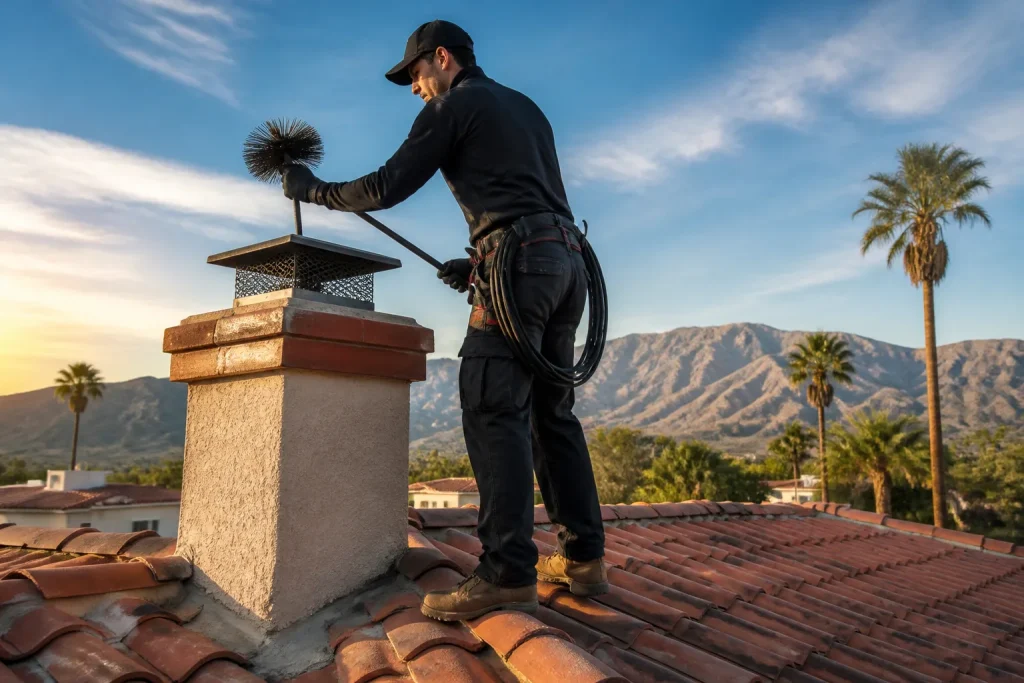
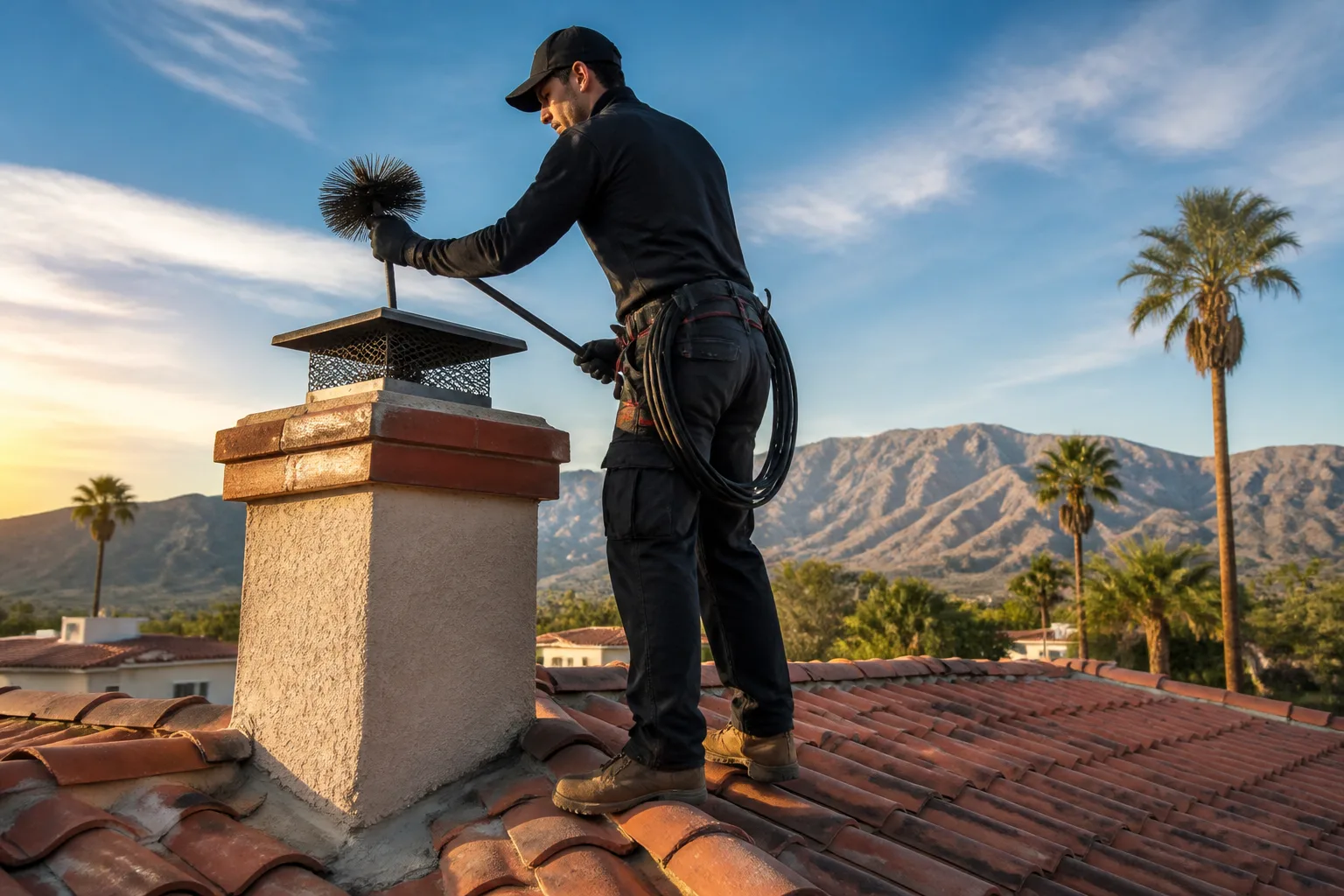
DuraFlex Chimney Sweep in Indio: A Homeowner’s Guide
DuraFlex is a UL-listed stainless steel chimney liner system that most certified sweeps in Indio recommend when a terra cotta flue has cracked or deteriorated to the point where it can no longer safely vent combustion gases. It costs more than an aluminum liner because it’s built for wood-burning temperatures, not just gas appliances, and it’s the material we turn to when a homeowner’s flue has failed. If you’re researching this because a sweep just told you that you need a new liner, or because a home inspection flagged your chimney, this guide explains what the product actually does, why it matters in the desert specifically, and what a proper installation looks like. And if you’d rather not sort through liner specs yourself, call (877) 378-2419 and we’ll walk you through it.
What DuraFlex Actually Is (And What It Isn’t)
DuraFlex is a flexible stainless steel chimney liner manufactured by Copperfield, one of the brands we stock because it’s what professionals specify for wood-burning fireplaces. The product is a continuous, corrugated tube that runs from the appliance or fireplace opening up through the full height of the chimney, giving combustion gases a contained path to the outside. The key word there is contained. Terra cotta tile flues work fine until they don’t, and when mortar joints crack or tiles shift, exhaust can bleed into the surrounding masonry, into wall cavities, or into the home itself.
Most DuraFlex liners used in Indio wood-burning applications are made from 316L stainless steel, which handles continuous temperatures up to 1,000°F and intermittent exposure up to 1,400°F. That matters because wood fires in desert homes burn hot, and a liner rated for lower temperatures, like an aluminum flex liner meant for a gas furnace, will fail prematurely if it’s used where it shouldn’t be. We’ve pulled aluminum liners out of wood-burning chimneys that looked like crumpled foil after two seasons. The material was never the problem. The application was.
- DuraFlex is: UL 1777-listed for wood-burning applications, flexible enough to navigate offsets in existing masonry, and available in diameters matched to the appliance’s venting requirements.
- DuraFlex is not: a surface coating, a repair patch for a few cracked tiles, or a product that can be installed over a flue that hasn’t been properly swept and inspected first.
- What gauge matters: DuraFlex comes in multiple wall thicknesses. Thinner gauges are easier to pull and cheaper, but a .005 gauge liner has a shorter service life than the .006 or heavier options. We spec based on what the existing chimney situation demands, not what keeps a bid low.
Why Indio Homes Need Relining More Often Than Homeowners Expect
Desert thermal cycling is hard on chimneys. Indio regularly swings 30 to 40 degrees between daytime highs and nighttime lows during the cooler months, and that repeated expansion and contraction stresses the mortar joints between terra cotta flue tiles. Each cycle is small, but over decades they add up. The mortar in a 40-year-old chimney in Indio has been through roughly 14,000 of those cycles. In a more temperate climate, that same chimney might take twice as long to reach the same state of deterioration.
What homeowners typically see first is a flake of terra cotta in the firebox, or a thin line of white staining on the exterior brick called efflorescence, which signals moisture moving through the masonry. By the time those signs appear, the flue has often already lost its structural integrity. A camera inspection usually confirms it: cracked tiles, missing mortar, gaps where sections have separated. That’s the point where a sweep recommends relining. It’s not an upsell. It’s a direct response to the condition of the venting system that carries fire exhaust out of your house. We repair what we find, and in Indio, what we find is often thermal fatigue.
If your chimney has already been flagged, the full scope of what’s involved lives on our Chimney Repair in Indio page, including when a liner is the right fix versus a rebuild.
The Installation Process, Step by Step
If you’re going to pay for a liner, you should know exactly what you’re paying for. A proper DuraFlex installation is not a two-hour job. Here’s what it looks like when it’s done correctly:
- 1
Sweep and inspection. The existing flue gets cleaned first. You can’t assess tile condition through a quarter inch of creosote, and you don’t want to seal debris behind a new liner. A camera goes down the flue before anything else happens.
- 2
Sizing. The liner diameter is matched to the appliance. For a typical wood-burning fireplace, that often means a 6-inch or 8-inch liner depending on the fireplace opening dimensions and the flue’s existing interior size. Undersizing chokes the draft and pushes smoke back into the room. Oversizing cools the gases too fast and accelerates creosote buildup.
- 3
Insulation. This is the step a lot of low-bid installers skip. The annular space (the gap between the new liner and the old flue walls) gets insulated on wood-burning applications. Insulation keeps flue gases hot enough to maintain draft and prevents condensation inside the liner, which is a primary driver of corrosion and creosote adhesion. It also provides a thermal barrier if the existing masonry has cracks that could transmit heat to nearby framing.
- 4
Pulling the liner. The DuraFlex is fed down the chimney from the top, connected to the appliance at the bottom, and secured at the termination point. A rain cap and spark arrestor go on top, and the connections get sealed with a high-temperature sealant.
- 5
Verification. After installation, we run a final camera pass to confirm the liner is seated correctly, the connections are tight, and there’s no visible deformation.
The difference between a good liner installation and a bad one is rarely visible from the outside. It shows up as draft problems in year two, or a creosote problem that a sweep shouldn’t be seeing in year three. A clean chimney and a safe dryer vent are the same category of problem: combustion risk. The same applies to the liner itself.
How a Properly Sized Liner Affects Draft and Creosote
Draft is not mysterious. A chimney works because hot gases rise and the flue gives them a contained channel to rise through. Surface area matters. An oversized flue cools gases before they reach the top, which drops the velocity and lets creosote condense on the liner walls. An undersized flue restricts the flow and sends smoke spilling back into the house.
Older Indio homes with large, original fireboxes often have flues that are oversized for modern fire-building habits. The classic symptom is a smoky room on mild days, or creosote buildup concentrated in the upper third of the chimney where gases have slowed and cooled. That’s a flue cross-sectional area problem, and relining with a properly sized DuraFlex liner is the standard fix. It reduces the effective flue diameter, which raises gas velocity, which keeps the exhaust temperature above the condensation point longer. The result isn’t just better draft. It’s measurably less creosote per season.
We’ve pulled a liner out of a house off Monroe Street where the homeowner had been fighting a smoky fireplace for six years. Original terra cotta flue was 13 by 13 inches, serving a fireplace that needed roughly an 8-inch round liner. That’s more than double the cross-sectional area it should have had. Relined it to spec, and the smoke issue was gone the first time she lit a fire. The math works.
Questions to Ask Any Contractor Proposing a Liner
If someone tells you that you need a new chimney liner, you’re entitled to answers to all of these before you sign anything:
- What UL listing covers the product you’re installing? If the answer is vague, walk away. Wood-burning applications require UL 1777 listing as a minimum standard.
- What stainless alloy is the liner, and what’s the wall thickness? 316L is what wood-burning requires. If they can’t tell you the alloy or the gauge, the price is probably the only thing they know about the product.
- Are you insulating the annular space? If they say insulation isn’t necessary for a wood-burning installation, get a second opinion. It is.
- Does the manufacturer warranty transfer to me as the homeowner? Some installers buy liner kits but register the warranty under their company name. Ask how the warranty gets transferred if you sell the house.
- Are you pulling a building permit? A liner installation is a code-governed modification to a venting system. In Indio and across Riverside County, unpermitted liner work can bite you at resale when a home inspector asks for the paperwork.
And when you call around in Indio, ask whether the company does the full scope of chimney work or just cleaning. A sweep who only cleans is going to refer you out for any repair. A company that does Chimney Sweep in Indio work plus repair and relining can handle the whole job without a middleman, and you’ll get a straight answer about what’s urgent and what can wait.
When a DuraFlex Liner Isn’t the Answer, and When It Is
Relining makes sense when the terra cotta flue has failed but the chimney structure itself is still sound. If the masonry is shifting, if there are cracks in the exterior brick that open and close with the seasons, or if the crown is failed and water has been getting into the system for years, a liner alone won’t solve the problem. It’s like putting a new exhaust pipe on a car with a cracked block. The part may be good, but the system around it is still failing.
In those cases, you’re looking at a rebuild or at minimum significant structural repair before a liner gets installed. The honest version is that most chimneys in Indio that need liners also need some level of masonry work, crown repair, or flashing replacement to make the liner worthwhile. We tell homeowners when work can wait and when it can’t. Nothing gets recommended without camera evidence you can see with your own eyes.
DuraFlex and Chimney Sweep Indio home guides are only useful if they help you make a decision with the right information. This one’s honest about the hard cases. A liner that’s installed over failed masonry is money spent on a temporary fix.
Related services in Indio
If you’re in the middle of a chimney repair project or a liner evaluation, it’s worth checking your dryer vent while you’re at it. Lint buildup is the same category of combustion risk, just with a lower temperature and a higher likelihood. Our Dryer Vent Cleaning in Indio service runs a camera through the vent and pulls out the accumulated lint that a brush can’t reach, and it’s the same team that handles your chimney work. One call covers both.
The Bottom Line
DuraFlex is the liner system we recommend for most Indio relining projects because it’s UL-listed for wood-burning temperatures, it’s available in the diameters and gauges the job actually requires, and when it’s installed with proper annular insulation, it solves the draft and creosote problems that a cracked terra cotta flue creates. The material choice matters less than the installation quality, but both have to be right. Ask questions. Get the camera footage. And don’t let anyone sell you a liner without a proper sweep and inspection first.
If you’re in Indio and need an honest assessment of your chimney, call (877) 378-2419 for a free estimate. We’ll put a camera down your flue, show you what we see, and tell you plainly whether a DuraFlex liner is the right fix or whether something else is going on. You’ll get the footage, not a sales pitch.
Frequently Asked Questions
A DuraFlex liner installation in Indio typically runs between $2,500 and $6,500 depending on liner diameter, length, insulation, and the condition of the existing masonry. A straight 6-inch liner in a single-story chimney with easy access lands at the low end. A two-story home, an 8-inch liner, heavy creosote buildup, or masonry repairs push the price up. The liner material itself is usually $25 to $45 per foot depending on gauge and diameter, but labor, insulation, termination, and any structural work dominate the final cost. Call (877) 378-2419 for an exact quote, and we’ll show you the camera footage behind our recommendation.
If a camera inspection shows cracked tiles, separated mortar joints, or gaps in the flue, the chimney is venting combustion gases outside of a contained pathway, and that’s a carbon monoxide and fire risk. You can’t see any of this from the firebox. Cracks form slowly and silently. A clean terra cotta flue with no visible defects does not need relining, and a reputable sweep will tell you that. The problem is that many Indio chimneys have never been inspected by camera, so the homeowner is gambling on a flue they’ve never actually seen. Get the inspection. If you need a liner, you need it. If you don’t, you’ll know that too.
Most homes in Indio that burn wood regularly should be swept once per year, ideally before the first cold snap of the season. The National Fire Protection Association’s standard (NFPA 211) says chimneys should be cleaned whenever creosote accumulation reaches 1/8 inch, and we find that threshold in regular-use fireplaces within a single burning season. If you burn mostly during a short winter window and use seasoned hardwood, you might get away with every other year. If you’re burning pine or construction scraps, or if you notice smoke backing into the room, more frequent sweeping is warranted. Give us a call at (877) 378-2419 and we’ll assess your specific burn pattern.
You accumulate creosote. Creosote is the tarry residue left behind when wood smoke condenses on the flue walls, and it’s flammable. A thick enough layer ignites into a chimney fire that can reach 2,000°F, crack the flue tiles or liner, and spread to the surrounding framing. Even without a fire, heavy creosote restricts draft, and restricted draft pushes carbon monoxide back into the living space. The risks compound silently. Most homeowners who skip annual sweeps don’t notice a problem until a home inspector flags the chimney at resale, or until the fireplace stops drafting entirely. The sweep is cheaper than the repair, every time.
Written by the team at Chimney Sweep Indio, serving Indio since 2015.
Need Chimney Cleaning Help?
Call Chimney Sweep Indio - licensed & insured, with free written estimates in Indio.
(877) 378-2419